Friday, January 30, 2015

Conic Section
Conic sections are the curves which can be derived from taking slices of a "double-napped" cone. (A double-napped cone, in regular English, is two cones "nose to nose", with the one cone balanced perfectly on the other.)
If you think of the double-napped cones as being hollow, the curves we refer to as conic sections are what results when you section the cones at various angles.
There are some basic terms that you should know for this topic: 
Center: the point (h, k) at the center of a circle, an ellipse, or an hyperbola. 
Vertex: in the case of a parabola, the point (h, k) at the "end" of a parabola; in the case of an ellipse, an end of the major axis; in the case of an hyperbola, the turning point of a branch of an hyperbola. 
Focus: a point from which distances are measured in forming a conic; a point at which these distance-lines converge, or "focus". 
Directrix: a line from which distances are measured in forming a conic. 
Axis: a line perpendicular to the directrix passing through the vertex of a parabola. 
Major axis: a line segment perpendicular to the directrix of an ellipse and passing through the foci; the line segment terminates on the ellipse at either end; also called the "principal axis of symmetry"; the half of the major axis between the center and the vertex is the semi-major axis. 
Minor axis: a line segment perpendicular to and bisecting the major axis of an ellipse; the segment terminates on the ellipse at either end; the half of the minor axis between the center and the ellipse is the semi-minor axis. 
Each conic has a "typical" equation form, sometimes along the lines of the following:
    parabola: Ax2 + Dx + Ey = 0
    circle: 
    x2 + y2 + Dx + Ey + F = 0
    ellipse: 
    Ax2 + Cy2 + Dx + Ey + F = 0
    hyperbola: 
    Ax2 – Cy2 + Dx + Ey + F = 0

Friday, January 23, 2015

Parabola
To form a parabola, you would start with a line and a point off to one side. The line is called the "directrix"; the point is called the "focus". The parabola is the curve formed from all the points (x, y) that are equidistant from the directrix and the focus. The line perpendicular to the directrix and passing through the focus (that is, the line that splits the parabola up the middle) is called the "axis of symmetry". The point on this axis which is exactly midway between the focus and the directrix is the "vertex"; the vertex is the point where the parabola changes direction.

The "vertex" form of a parabola with its vertex at (h, k) is: regular: y = a(x – h)2 + k sideways: x = a(y – k)2 + h
The conics form of the parabola equation (the one you'll find in advanced or older texts) is: regular: 4p(y – k) = (x – h)2 sideways: 4p(x – h) = (y – k)2
The relationship between the "vertex" form of the equation and the "conics" form of the equation is nothing more than a rearrangement: y = a(x – h)2 + k y – k = a(x – h)2 (1/a)(y – k) = (x – h)2 4p(y – k) = (x – h)2

Tuesday, January 6, 2015

                                                                  1st semester 
3 things done well
I didn't do very well first semester. I did well on memorizing the trigonometric identities. I did well on knowing how to solve majority of the trigonometric identities. But for the majority of math, essentially chapters 2-4, I did not do well on. 
3 Goals to improve on
Whenever I need help, I would to come to Ms. V before a test and especially as soon as possible. I need to study more, if I did not get a chance to ask for help. Also I need to resolve my internet issue quicker. 
Favorite Christmas break story
My dad and his friend kept arguing whether to celebrate and eat on Christmas Eve or on Christmas Day. 

Thursday, December 4, 2014

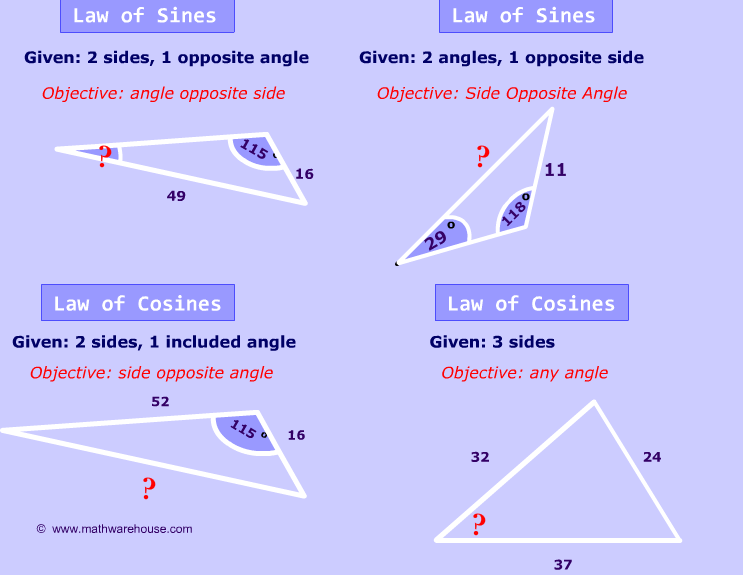
Law of Sine and Cosines
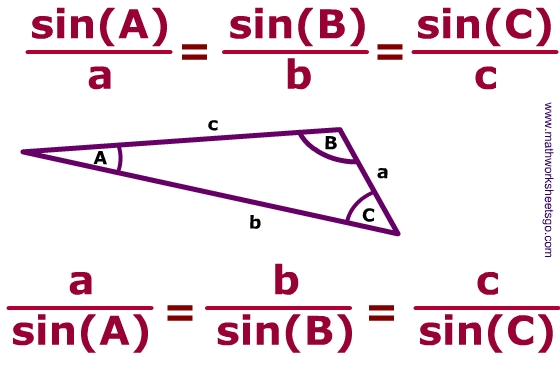
When learning how to use trigonometry to solve oblique triangles, it is most important to know when and how to use these two laws. If that’s enough for you, then just skip on to the next section on area of a triangle. But if you’re interested in why they’re true, then continue on. As usual, we’ll use a standard notation for the angles and sides of a triangle. 
The Law of Sines
 That means the side a is opposite the angle A, the side b is opposite the angle B, and the side c is opposite the angle C.

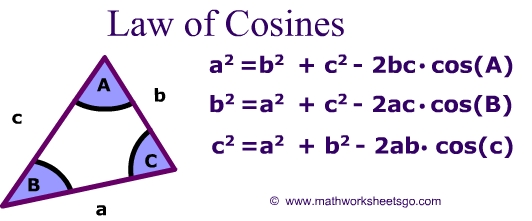
The law of cosines
There are two other versions of the law of cosines: a2 = b2 + c2 – 2bc cos Aandb2 = a2 + c2 – 2ac cos B.Since the three verions differ only in the labelling of the triangle, it is enough to verify one just one of them. We’ll consider the version stated first.In order to see why these laws are valid, we’ll have to look at three cases. For case 1, we’ll take the angle C to be obtuse. In case 2, angle C will be a right angle. In case 3, angle C will be acute.
Math Joke of the Week: 
Q: What is the definition of a polar bear?
A: A rectangular bear after a coordinate transformation


Friday, November 21, 2014

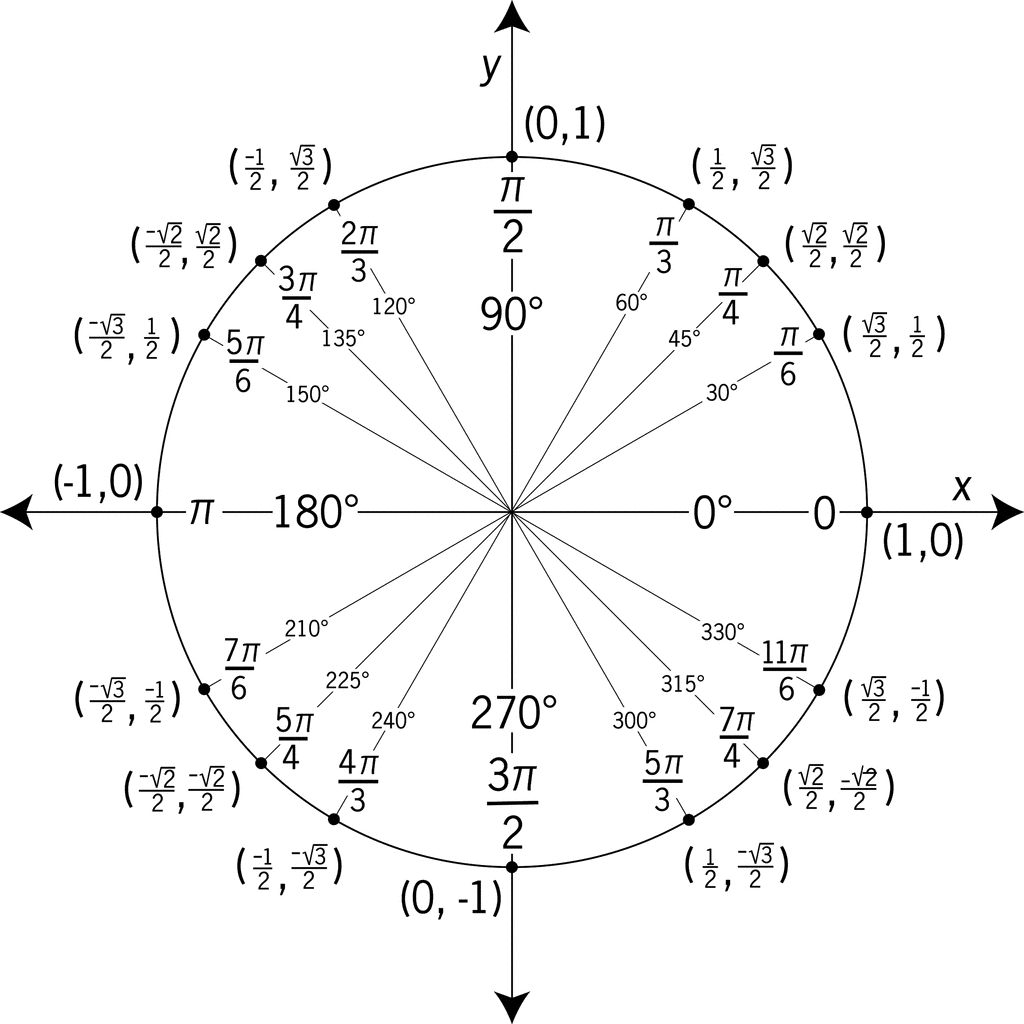
Unit Circle
In mathematics, a unit circle is a circle with a radius of one. Frequently, especially in trigonometry, the unit circle is the circle of radius one centered at the origin (0, 0) in the Cartesian coordinate system in the Euclidean plane. The unit circle is often denoted S1; the generalization to higher dimensions is the unit sphere.If (x, y) is a point on the unit circle, then |x| and |y| are the lengths of the legs of a right triangle whose hypotenuse has length 1. Thus, by the Pythagorean theorem, x and y satisfy the equationx^2 + y^2 = 1.
Math Joke of the week:
Q: Why didn't sin and tan go to the party?
A: Just cos

Thursday, November 20, 2014

Chapter 4 summary
 Relating the sides of triangles to the unit circle, which accounts for special triangles and angles. The things to remember are (cos,sin) = (x,y), and cosine is equivalent to adjacent side over hypotenuse, whereas sine is opposite over hypotenuse and tangent is opposite over adjacent. This information allows us to find the points along the unit circle, finding the coordinates along the circumference using 45-45-90 and 30-60-90 right triangles sine and cosine values. Also, we learned that trigonometry has many identities, which are tools used for trigonometric equations to solve. We can prove the existence of these identities using verifying. Inverses are for solving for arcsin1/2 and we are solving for x. We solve by taking the sin^-1 of 1/2 and that is x.

Math Joke of the Week:
Q: What do you get when you cross a mosquito with a mountain climber?
A: Nothing. You can't cross a vector and a scalar.

Wednesday, November 12, 2014

Trigonometric Equations
Solving trig equations use both the reference angles you've memorized and a lot of the algebra learned.
Solutions of trigonometric equations may also be found by examining the sign of the trig value and determining the proper quadrant(s) for that value. 
Be prepared to solve sin(x) + 2 = 3 for 0° < x < 360°
Just as with linear equations, I'll first isolate the variable-containing term:   sin(x) + 2 = 3   sin(x) = 1
Now use the reference angles memorized:   x = 90°
Solve tan2(x) + 3 = 0 for 0° < x < 360°
There's the temptation to quickly recall that the tangent of 60° involves the square root of 3 and slap down an answer, but this equation doesn't actually have a solution:tan2(x) = –3
How can the square of a trig function evaluate to a negative number? It can't, no solution

Math Joke of the week:
Q: What did one Calculus book say to the other?
A: Don't bother me I've got my own problems!